
Signal that holds when lives depend on it
Pass ERCES inspection the first time
ERCES designed, installed, and certified to IFC 510 and NFPA 1225, 150+ systems delivered, with first-pass AHJ approval to date.
- General coverage at benchmark (FAIL)
- 33%
- General coverage at benchmark (FAIL)
- General coverage at acceptance (PASS)
- 98%
- General coverage at acceptance (PASS)
- Critical-area coverage at acceptance (PASS)
- 99%
- Critical-area coverage at acceptance (PASS)
- Sq ft brought into ERCES compliance
- 15M+
- Sq ft brought into ERCES compliance
The grid test
From dead zones to code-compliant coverage
Every ERCES project starts and ends with the same test: the building is divided into measurement grids, each one passes or fails, and compliance is the share that passed.
The process
How the ERCES process works
Site Survey
Benchmark grid test
We divide your building into a measurement grid and test the existing public-safety signal floor by floor against the code standard of 95% coverage in general areas and 99% in critical areas.
Why it matters: A documented failing test is what legally triggers an ERCES, and it pinpoints exactly where signal dies so nothing is guessed.
Outcome: a baseline coverage map of your building's dead zones
Design
iBwave predictive modeling
Your building is modeled in iBwave and a system is engineered to hit code coverage with margin. We set the head-end location, antenna placement, and signal balancing across every floor and zone.
Why it matters: Predictive modeling means we know the design passes before a single component is installed.
Outcome: a sealed design package with predicted coverage heat-maps
AHJ Submittal
Permit & fire-marshal review
We file the permit set and coordinate the design up front with your local Authority Having Jurisdiction (the fire marshal).
Why it matters: Pre-approval coordination is why every system to date has passed on the first inspection, with no surprises on the day.
Outcome: an approved, permitted plan ready to build
Installation
Code-built & monitored
The system is installed to the approved design, in fire-rated pathways, with battery backup and fault monitoring tied to your fire alarm panel.
Why it matters: A clean, code-built installation is what survives both inspection and a real emergency.
Outcome: a fully installed, continuously monitored system
Acceptance Testing
Prove it passes
We repeat the same grid test on the finished system to prove 95% / 99% coverage, and verify backup power and monitoring.
Why it matters: Objective, documented proof the system meets code, in writing, before inspection.
Outcome: an AHJ-ready acceptance report with RSSI coverage maps
Certification
Signed off & occupied
The AHJ inspects, signs off, and certifies the system, which clears the public-safety requirement on your Certificate of Occupancy.
Why it matters: This is the approval that lets you legally occupy and operate the building.
Outcome: certification plus an annual-test plan to stay compliant
Free checklist
Before you fail inspection
A two-minute risk check and the one-page ERCES checklist the inspector works from. For developers, architects, GCs, and property managers who are not at inspection yet, and would rather not get there unprepared.
The problem
Your building is blocking emergency signals
Modern construction materials such as low-E glass, concrete, and metal cladding kill up to 80% of public-safety radio signal. Without a code-compliant ERCES, first responders cannot communicate inside your building, and the fire marshal will not clear your Certificate of Occupancy.
| Material | Loss | Note |
|---|---|---|
| Low-E glass | 30 dB | per pane |
| Concrete floor | 15 dB | per level |
| Metal cladding | 40 dB | |
| Parking garage | 50 dB | below grade |
| Elevator shaft | Total block | dead zone |
Low-E glass
- Loss:
- 30 dB
- Note:
- per pane
Concrete floor
- Loss:
- 15 dB
- Note:
- per level
Metal cladding
- Loss:
- 40 dB
- Note:
Parking garage
- Loss:
- 50 dB
- Note:
- below grade
Elevator shaft
- Loss:
- Total block
- Note:
- dead zone
What it costs you
- 01No occupancy permitThe fire marshal won't sign off.
- 02Daily finesBilled every day until it passes.
- 03LiabilityOn you if responders can't communicate inside.
- 04Denied claimsInsurers can contest a known gap.
- 05Stop-work ordersRenovations halt until it's fixed.
The difference
What a grid test changes
A failing benchmark test is the legal trigger for an ERCES. The building starts at 33% general coverage (FAIL). A donor antenna on the roof, a bi-directional amplifier, and a coax riser then carry public-safety signal to every floor, the outcome we engineer and then prove with an on-site grid test.
Every ERCES project starts and ends with the same test: the building is divided into measurement grids, each one passes or fails, and compliance is the share that passed.
- General coverage at benchmark (FAIL)
- 33%
- General coverage at benchmark (FAIL)
- General coverage at acceptance (PASS)
- 98%
- General coverage at acceptance (PASS)
- Critical-area coverage at acceptance (PASS)
- 99%
- Critical-area coverage at acceptance (PASS)
- Sq ft brought into ERCES compliance
- 15M+
- Sq ft brought into ERCES compliance
Benchmark grid test
The building is divided into measurement grids and the existing public-safety signal is tested floor by floor. Each grid passes or fails.
Design, install, validate
The system is engineered, built to the approved design and validated on site.
Acceptance grid test
The same grid test is repeated on the finished system. Compliance is the share of grids that passed.
| Floor | Before (dBm) | Before coverage | After (dBm) | After coverage |
|---|---|---|---|---|
| F7 | −122 | 4% | −78 | 95% |
| F6 | −118 | 8% | −74 | 96% |
| F5 | −110 | 16% | −70 | 97% |
| F4 | −104 | 27% | −67 | 99% |
| F3 | −96 | 41% | −63 | 98% |
| F2 | −88 | 58% | −60 | 99% |
| G | −72 | 78% | −58 | 99% |
| Whole building | 33% (FAIL) | 98% general, 99% critical (PASS) |
F7
- Before (dBm):
- −122
- Before coverage:
- 4%
- After (dBm):
- −78
- After coverage:
- 95%
F6
- Before (dBm):
- −118
- Before coverage:
- 8%
- After (dBm):
- −74
- After coverage:
- 96%
F5
- Before (dBm):
- −110
- Before coverage:
- 16%
- After (dBm):
- −70
- After coverage:
- 97%
F4
- Before (dBm):
- −104
- Before coverage:
- 27%
- After (dBm):
- −67
- After coverage:
- 99%
F3
- Before (dBm):
- −96
- Before coverage:
- 41%
- After (dBm):
- −63
- After coverage:
- 98%
F2
- Before (dBm):
- −88
- Before coverage:
- 58%
- After (dBm):
- −60
- After coverage:
- 99%
G
- Before (dBm):
- −72
- Before coverage:
- 78%
- After (dBm):
- −58
- After coverage:
- 99%
Whole building
- Before (dBm):
- Before coverage:
- 33% (FAIL)
- After (dBm):
- After coverage:
- 98% general, 99% critical (PASS)
Code minimum: at least 95% general and 99% critical coverage at or above −95 dBm, per IFC 510 and NFPA 1225. Illustrative, modeled on a real 7-floor project. This building: 81,706 sq ft.
The system types, in detail
Passive and hybrid DAS
Passive and hybrid DAS, how each one is built, and which size of building each one suits.
Passive DAS
A single bi-directional amplifier distributes public-safety signal over coaxial cable, the most cost-effective path to fire-code compliance. Best fit: up to 250,000 sq ft.Learn moreHybrid DAS
A fiber-optic backbone feeds distributed remote units throughout the building, ideal for large, complex, or multi-building layouts. Best fit: up to 1,000,000 sq ft.Learn more
Technical specifications
Passive vs. Hybrid at a glance
Two proven approaches. Different strengths. Same mission: reliable coverage where it matters.
| Specification | 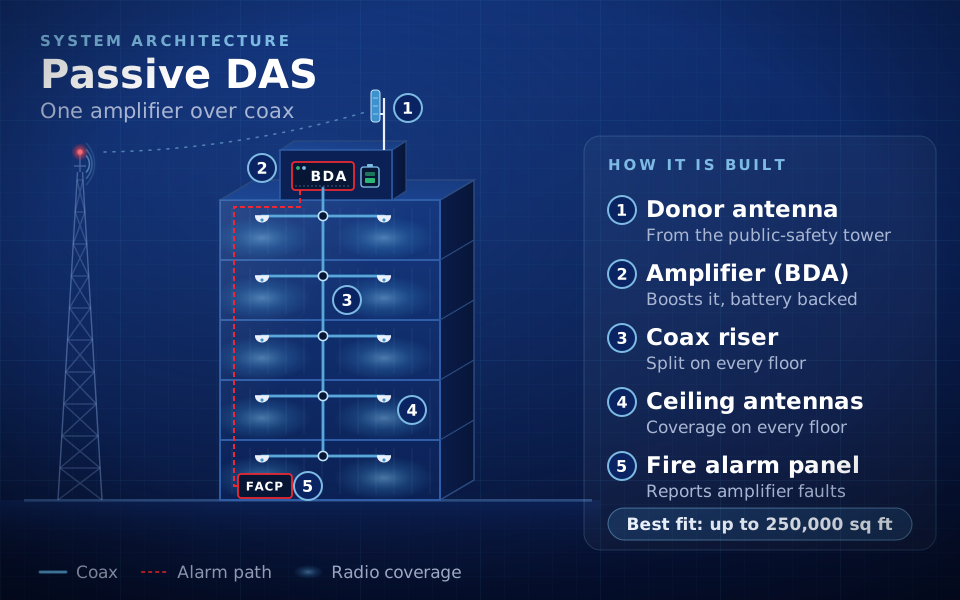 Passive DAS (single amplifier over coax) | 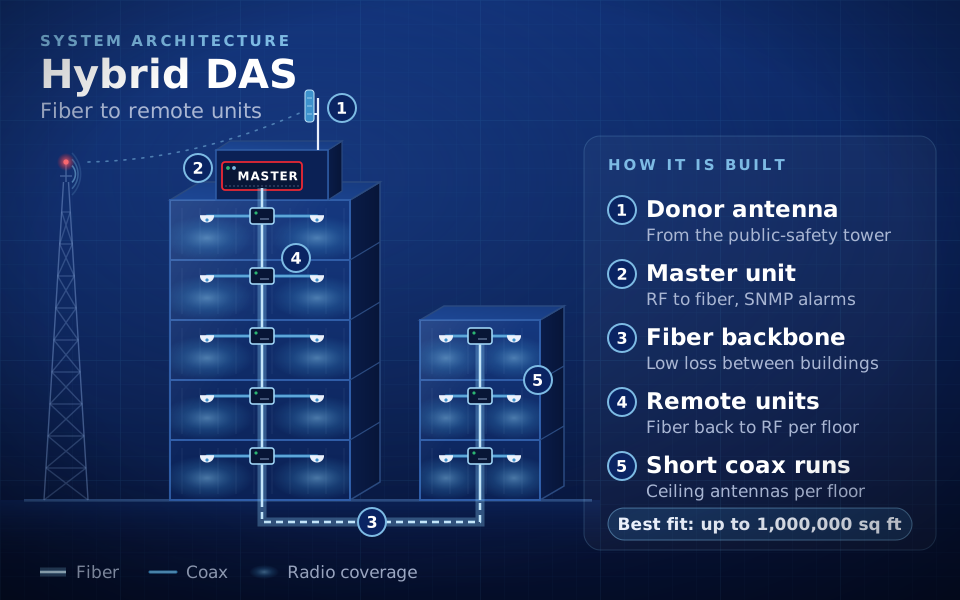 Hybrid DAS (fiber backbone plus remotes) |
|---|---|---|
| Architecture | All-RF passive over coaxial cable | Fiber backbone + coax distribution |
| Best fit | Single buildings with short cable runs | Large or multi-building footprints: campuses, hospitals, high-rises |
| Coverage target | 95% general / 99% critical | 95% general / 99% critical |
| Scalability | Add coax runs, splitters, antennas | Modular fiber expansion |
| Redundancy | Battery backup at the amplifier; redundant donor | Dual fiber paths; redundant power |
| Management | Dry-contact alarms to the fire alarm panel | SNMP v3 + web monitoring |
Architecture
- Passive DAS (single amplifier over coax):
- All-RF passive over coaxial cable
- Hybrid DAS (fiber backbone plus remotes):
- Fiber backbone + coax distribution
Best fit
- Passive DAS (single amplifier over coax):
- Single buildings with short cable runs
- Hybrid DAS (fiber backbone plus remotes):
- Large or multi-building footprints: campuses, hospitals, high-rises
Coverage target
- Passive DAS (single amplifier over coax):
- 95% general / 99% critical
- Hybrid DAS (fiber backbone plus remotes):
- 95% general / 99% critical
Scalability
- Passive DAS (single amplifier over coax):
- Add coax runs, splitters, antennas
- Hybrid DAS (fiber backbone plus remotes):
- Modular fiber expansion
Redundancy
- Passive DAS (single amplifier over coax):
- Battery backup at the amplifier; redundant donor
- Hybrid DAS (fiber backbone plus remotes):
- Dual fiber paths; redundant power
Management
- Passive DAS (single amplifier over coax):
- Dry-contact alarms to the fire alarm panel
- Hybrid DAS (fiber backbone plus remotes):
- SNMP v3 + web monitoring
Code compliance
Every requirement for AHJ approval
Miss any one, and the system is rejected. We verify every requirement before installation, and every project to date has passed on the first try.
- Requirements
- 8
- Requirements
- Must pass
- 100%
- Must pass
- Projects approved
- 150+
- Projects approved
- Rejections
- 0
- Rejections
The eight requirements
Coverage
95% General Coverage
Minimum −95 dBm signal strength in all general areas.
99% Critical-Area Coverage
Stairwells, fire command center, pump rooms, exit corridors, elevator lobbies.
Equipment
UL 2524 Listed Equipment
All signal boosters listed specifically for in-building public safety.
2-Hour Fire-Rated Pathways
Cable routes protected by 2-hour rated enclosures or CI cable.
Power
Battery Backup
At least 12 hours of standby power under current IFC and NFPA editions (24 hours under IFC 2015 or where the AHJ requires it). We design to 24 hours.
Dedicated 20A Circuit
GFCI protected, on emergency power where available.
Monitoring
FACP Monitoring
System trouble and antenna malfunction alarms to the fire panel.
Annual Testing
Recertification by a qualified vendor every 12 months.
IFC 510
International Fire Code
Mandates in-building public-safety radio coverage of 95% general and 99% critical area for first responders.
NFPA 1225
Emergency Responder Communications
The 2022 standard for ERCES coverage, survivability, and monitoring, which replaces NFPA 1221.
UL 2524
In-Building Signal Boosters
The listing standard every public-safety signal booster and BDA must meet under IFC 2021.
FCC Part 90
Public-Safety Radio
Federal rules that keep the system from interfering with other licensed bands.
What you receive
An AHJ-ready grid test report
Every project includes documented RSSI coverage maps and compliance paperwork your fire marshal can sign off on.
- Detailed coverage maps
- AHJ-compliant documentation
- 24/7 emergency support
- Area coverage per code-required grid testing
- 95%+
- Area coverage per code-required grid testing
- Minimum signal strength (per AHJ requirement)
- −95 dBm
- Minimum signal strength (per AHJ requirement)
- Alarm monitoring
- 24/7
- Alarm monitoring
Code-required grid test summary, formatted for fire-marshal sign-off. Pass: −95 dBm or stronger. Fail: weaker than −95 dBm.
Investment
One fixed price, certification included
ERCES Ready bundles every phase from survey to AHJ sign-off into one scoped price. No surprise change orders, and if the design passes on paper, it passes on the grid, or we fix it at our cost.
ERCES Ready is our complete turnkey compliance package, covering site survey, iBwave design, installation, AHJ certification, and a 1-year warranty. We provide a fixed-price quote after your site survey, with no hidden change orders.
- ERCES projects delivered
- 150+
- ERCES projects delivered
- First-pass AHJ approval, every system to date
- 100%
- First-pass AHJ approval, every system to date
- Design to grid test
- 3–6 wk
- Design to grid test
- Warranty included
- 1 yr
- Warranty included
- Hidden change orders
- $0
- Hidden change orders
Site Survey
RF grid testing of existing conditions.
Design
iBwave model and full system specification.
Installation
Professional installation and setup.
Acceptance
Grid testing and compliance verification.
Certification
AHJ inspection and final sign-off.
WZC Compliance Care
WZC Compliance Care covers the annual re-test that IFC 510 and NFPA 1225 require, and the report most AHJs want on file: annual grid re-test and recertification, 24/7 BDA and FACP alarm monitoring, battery replacement on schedule, the AHJ documentation package, and priority emergency response. Available for systems we installed and systems we did not: one accountable partner, from the first grid test to every recertification after it.
Already have an ERCES? Annual recertification is due every 12 months: schedule yours.
- Annual grid re-test and recertification
- 24/7 BDA and FACP alarm monitoring
- Battery replacement on schedule
- The AHJ documentation package
- Priority emergency response
Recent ERCES installations
Buildings we brought into compliance
Senior Living
100%grid pass rate at acceptanceERCES coverage from 51% to 100% in four days
A 15-story senior-living high-rise failing public-safety coverage at 51%, brought to full compliance in four days.Read case studyRetail
50+sites deliveredERCES compliance across 50+ store deployments
Turnkey ERCES for new and existing supercenters, grid testing, design, install, AHJ approval, commissioning.Read case studyHotel / Hospitality
1stpass AHJ approvalFailing benchmark to first-pass AHJ approval
A 7-floor hotel that failed its public-safety benchmark test, brought to full code coverage and approved on the first inspection.Read case study
ERCES FAQs
How long does installation take?
Typically 3–6 weeks end to end. An emergency fast-track is available in about 2 weeks for citation or CO-pending situations.
Will it interfere with cellular or Wi-Fi?
No. ERCES operates on dedicated public-safety frequencies (VHF, UHF, 700 MHz, and 800 MHz) and is FCC Part 90 compliant, so it does not interfere with cellular or Wi-Fi.
What maintenance is required?
NFPA 1225 and IFC 510 require annual testing and recertification by a qualified vendor. Plan on periodic inspections and battery replacement every 3 to 5 years. We offer maintenance contracts that cover all of it.
What happens if we fail AHJ inspection?
Every ERCES project to date has passed AHJ inspection the first time, through pre-approval coordination with the fire marshal. If an inspection finds a deficiency in our design or installation, we resolve it at no additional cost.
Do you work with existing fire alarm systems?
Yes. We integrate with the major fire alarm control panel brands, coordinating the supervised alarm connections with your fire alarm contractor as part of the design.
What frequencies are supported?
VHF (150–174 MHz), UHF (450–470 MHz), 700 MHz public safety, and 800 MHz public safety bands.
How much does a passive DAS cost?
Cost depends on building size, layout complexity, construction materials, and local AHJ requirements. We provide a fixed-price quote after a site survey, with no hidden change orders.
Can we upgrade to hybrid later?
Yes. Passive systems can be expanded, and we design with future growth in mind so you can scale to hybrid/active as needs change.
Who is responsible for ERCES: owner, tenant, or the GC?
The building owner, in almost every jurisdiction. A general contractor carries it through construction and hands it over at closeout, and a tenant fit-out can break coverage the owner is still answerable for. A few jurisdictions word it differently, so confirm it with your AHJ before the lease or the contract is signed rather than after.
What does annual recertification involve, and what does it cost?
A qualified vendor re-tests the building on the same grid the AHJ accepted, verifies the BDA, the alarms and the standby batteries, and files a report. Cost is quoted per building, because a fifteen-story high-rise and a single-story store are not the same visit. Tell us the building and the system and you will have a figure within one business day.
Can WZC take over a system another vendor installed?
Yes, and it is a large part of what WZC Compliance Care is for. The first visit is a full benchmark grid test against the original acceptance criteria, so both sides know exactly where the building stands before anyone commits to anything longer than a year.
Which Michigan jurisdictions enforce IFC 510?
Most that have adopted the International Fire Code, which in Michigan is the majority of municipalities, but adoption dates, amendments, and the coverage threshold differ from one AHJ to the next, and a neighboring city can enforce a different edition. We confirm the adopted code and the local amendments with your AHJ as the first step of a grid test, before anything is designed.
Get the same results for your building
Tell us about your building and timeline. Our ERCES experts will assess your situation and recommend the most cost-effective path to compliance.
- Engineered for compliance
- Built for reliability. Designed for you.
- Response within one business day