
Network Infrastructure
Wi-Fi engineered for the people in the building
We design Wi-Fi around real users, devices and applications, then validate performance on site before handoff.
How it works
Coverage that overlaps, so devices never drop
Access points are placed so their cells overlap, and a device walking the floor hands off to the next one without a gap.
How it works
Our process
Every WZC Wi-Fi deployment runs in a closed loop, tuned and re-surveyed until the measured heatmap meets the predictive design targets.
Survey & requirements
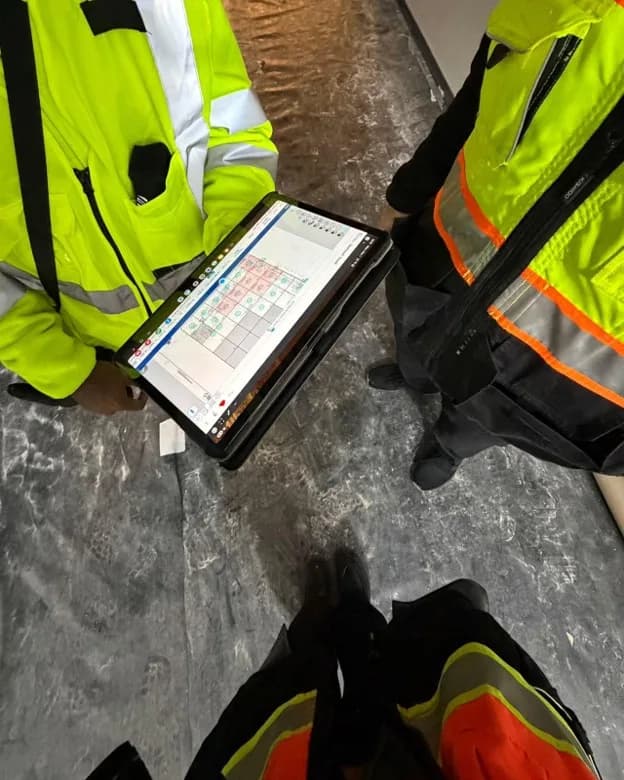
On-site AP-on-a-stick survey, spectrum analysis, device counts, and the application load the network must carry.
Predictive design
iBwave and Ekahau model to capacity targets, with AP placement and a cabling schedule.
Install & configure
APs, cabling and configuration, built to the drawing.
Validation survey
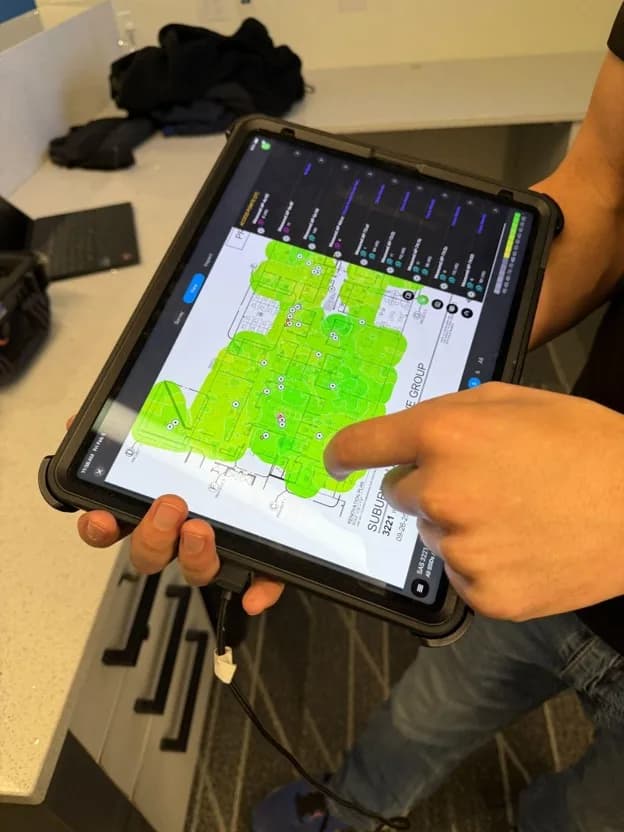
Walked and measured on site against the design targets, then tuned.
Annual maintenance
Health review, firmware, and a re-survey after a tenant fit-out or a layout change, under a Managed Network Services agreement.
The WZC approach
Modeled before we deploy. Validated after.
From manufacturing floors to multi-building campuses, WZC designs Wi-Fi that performs under real-world density. We model coverage before we deploy and validate it after.
Designed in iBwave and Ekahau, built on the platform that fits your standard: we are certified on Extreme Networks and Juniper Mist, and we design and install to a client's existing standard where one is already in place.
How it works
Survey
An AP-on-a-stick survey or a predictive model sets every AP position before anything is purchased.
Cable
Each AP gets PoE++ back to the controller over structured cabling.
Overlap
Cells are planned to overlap so there is no gap between them.
Roam
Fast transition hands the client off mid-call without a drop.
System components
Controller / Gateway
Central RF management, roaming policy and segmentation.
Wi-Fi 6E / Wi-Fi 7 Access Points
Ceiling-mounted, positioned from a validated site survey.
Structured Cabling
Certified Cat6A runs delivering PoE++ to every access point.
Seamless Roaming
802.11r/k/v fast transition so sessions survive the handoff.
- Standard
- Wi-Fi 6E / Wi-Fi 7
- Survey
- Predictive + validated
- Roaming
- 802.11r/k/v fast transition
- Uplink
- PoE++ structured cabling
- Density
- Designed per client count
What you get
Designed for density. Proven on deployment day.
AP-on-a-stick survey or predictive survey design
Measured in place or modeled in iBwave and Ekahau, for capacity, not just coverage.
Validated performance
A post-install validation survey: coverage and SNR heatmaps, throughput, and roaming walked on site.
Wi-Fi 6E / Wi-Fi 7
Designed for voice, video and mobile workflows, on current radios.
Cat6A with PoE sized to the AP
The cabling and the power budget are part of the design, not an afterthought for the installer.
From transit garages to college campuses, WZC Wi-Fi is engineered against real application loads, then walked, measured, and tuned on site before handoff.
“They have provided me with excellent support, always responding quickly and efficiently. Fast, cost-effective, and great value, I highly recommend WZC.”
 Julia ReynardSMART Bus
Survey & design
Design packages that stand on their own
The design is a deliverable, not a stage. Buy it on its own and hand it to whichever integrator builds the job, including one that is not us.
Deliverables: coverage and capacity heatmaps, AP placement drawings, a cabling schedule, a bill of materials, and a validation report your integrator or ours can build from.
Predictive design
For greenfield sites. Modeled from the drawings: bid-ready AP placement, bill of materials and a cabling schedule, before a single wall exists.
AP-on-a-stick survey
For vendor changes and high-stakes spaces. The proposed access point is tested in place, in your building, before anything is purchased.
Hybrid survey
For occupied buildings. A passive survey of the network you have, plus a predictive design for the refresh, so the cutover is planned rather than discovered.
Proof
Networks we designed, and then measured
Public Transit
73access points deployed472,449 sq ft transit Wi-Fi overhaul
A full enterprise Wi-Fi overhaul across a 472,449 sq ft transit facility, indoor and outdoor.Read case studyHealthcare
100%coverage validatedPredictive Wi-Fi modeling for critical care
Predictive Wi-Fi modeling for a major children's hospital to ensure reliable coverage in critical-care areas.Read case studyEducation
275+buildings surveyedCampus-wide RF survey & wireless design
Pre-site survey designs across academic, administrative, and residential buildings on one of the largest U.S. campuses.Read case study
Related services
- Wi-Fi Site Survey, RF Survey & iBwave Design ServicesBenchmark grid tests, RF site surveys, predictive Wi-Fi design and bid-ready drawings, sold on their own, whether or not WZC does the install.
- Managed Network Services24/7 NOC monitoring, proactive maintenance, and SLA response for the systems in your buildings, whoever installed them.
FAQs
Which hardware do you deploy?
We are certified on Extreme Networks and Juniper Mist, and we design on whatever standard your organization has chosen, including Cisco/Meraki and Aruba.
Do you handle high-density venues?
Yes, convention centers, transit facilities, warehouses, and campuses are core to our work.
Can you do just the survey and design?
Yes. It is a scoped, fixed-fee engagement, and architects, GCs and other integrators buy WZC design packages for buildings we will never install. The deliverable is the drawing set, and it is yours to build from or to put out to bid.
What is an AP-on-a-stick survey, and when do we need one?
The access point you are proposing is mounted temporarily in the real space and measured where it will actually live. It earns its cost when the vendor is changing, when the space is unusual (atria, warehousing, stone, glass, heavy racking) or when the purchase is large enough that being wrong about it is expensive.
Do you support Wi-Fi 7 and 6 GHz?
Yes. Whether it is the right answer depends on what your clients actually have: 6 GHz is only useful to devices that can see it, and a fleet of older handhelds will not. We design for the device population in the building, not for the newest standard on the datasheet.
We are standardized on Cisco or Meraki: can you still design and install it?
Yes. The design is engineered around your building and your standard rather than around a product we prefer to sell. Confirm the platform with us and the model is built on it.
How do you handle Wi-Fi in a building that also needs cellular DAS and ERCES?
As one RF plan rather than three. The three systems share pathways and headend space, and designing them together is the reason they fit: in most buildings they were designed by three different firms who never spoke, and the building pays for that in dead zones and duplicated risers.
Can you manage the network after installation?
Yes, under Managed Network Services: 24/7 NOC monitoring, firmware, proactive maintenance and an annual health review. A re-survey after a tenant fit-out or a layout change is part of it, because a network designed for one floor plan is not designed for the next one.
How do you run a multi-site rollout?
One design and one standard, repeated site after site, with a single point of contact and consolidated reporting. The twentieth location is documented exactly like the first, which is the whole reason a portfolio owner uses one vendor instead of twenty.
Let's solve your wireless challenge
Tell us about your building and goals. A WZC engineer will get back to you within one business day.